If you have a credit score below 600 or a history of missed payments, seeing “No Credit Check Loans” can feel like a lifeline. But is it actually possible to borrow money in Canada without anyone looking at your financial history? The short answer is: Not exactly.
| $1,000 |
| $3,000 |
| $5,000 |
While some lenders may not pull your file from Equifax or TransUnion, no legitimate lender hands out cash blindly. Instead of your credit score, they look at your banking history.
This guide explains how “no credit check” lending really works in Canada, the role of Instant Bank Verification (IBV), and the safer alternatives available to you.
What Does “No Credit Check” Actually Mean?
In the Canadian lending market, this term is often marketing shorthand. It usually means one of two things:
- No “Hard” Credit Check: The lender will not perform a hard inquiry on your credit report, which means applying won’t lower your score further.
- Alternative Data Approval: Instead of judging you on past mistakes (your credit score), the lender judges you on your current situation (your bank statement).
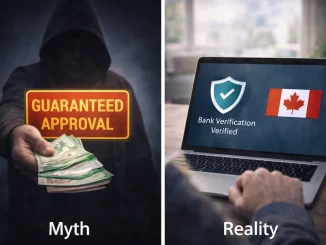
The IBV Shift: Most modern Canadian lenders use Instant Bank Verification (IBV) tools like Flinks to scan your bank account. If they see regular income and no NSF (Non-Sufficient Funds) fees, they may approve you even with bad credit.
Is It Legal? (The Federal Rules)
Yes, it is legal for lenders to offer loans without checking your credit score, provided they follow federal and provincial regulations.
However, recent changes to the Criminal Code of Canada have lowered the maximum allowable interest rate (APR) to 35% for most installment loans. Payday loans are regulated differently by each province (e.g., Ontario, BC, Alberta).
Warning: If a lender promises “Guaranteed Approval” regardless of your income, they are likely operating illegally. All legal lenders must assess your ability to repay.
Realistic Loan Options available
When you search for these loans, you will typically find three types of products:
1. Payday Loans
These are small, short-term loans (up to $1,500) regulated by your province. They do not usually require a credit check but are extremely expensive. You typically repay them via pre-authorized debit on your next payday.
2. Installment Loans
These allow you to borrow larger amounts (e.g., $500 – $5,000) and repay over several months. Lenders like EasyFinancial or Fairstone may do a “soft check” but focus heavily on your income.
3. Title Loans
If you own a vehicle fully (no payments left), you can use it as collateral. Because the loan is secured, the lender cares less about your credit score.
For a deeper dive into the myths surrounding these products, read our guide on Can You Really Get a No Credit Check Loan in Canada?.
The “IBV” Checklist: What Lenders Check Instead
If they aren’t looking at your Equifax score, what are they looking at? Lenders use your bank statement to check:
- Income Consistency: Do you have a steady source of funds (Employment, CPP, OAS, or CCB)?
- NSF Fees: Do you frequently bounce payments? This is a major red flag.
- Gambling: Frequent transactions to betting sites or casinos can cause an automatic decline.
- Day-to-Day Balance: Do you end the month with at least some money left over?
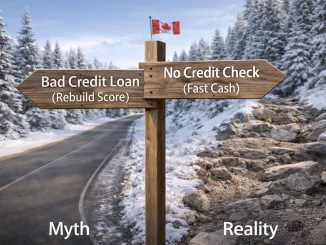
Understanding this distinction is key. Learn more in our comparison of Bad Credit vs. No Credit Check Loans.
The Risks: Higher Costs for Lower Scores
The trade-off for skipping the credit check is cost. These loans carry significant risks:
The APR Trap:
While a standard bank loan might be 8-12%, alternative lenders often charge between 29% and 49% (depending on the loan type). A $500 loan can quickly turn into $800 of debt if not managed carefully.
Safer Alternatives in Canada
Before you sign a high-interest contract, consider these Canadian support systems:
1. Credit Counselling Canada
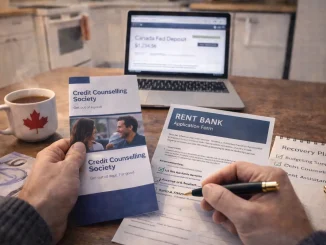
Non-profit agencies can help you manage debt and negotiate with creditors without taking new loans.
2. 211 Services
Dialing 2-1-1 connects you with local community resources, including food banks, rent banks (in BC and Ontario), and emergency utility support.
3. Secured Credit Cards
If your goal is to rebuild credit, a secured card (like those from Capital One or Home Trust) is safer than a high-interest loan.
Explore more options in our full guide to Alternatives to No Credit Check Loans in Canada.
Who Is This Guide For?
This guide is designed for Canadians who:
- Have a credit score under 600 and have been declined by major banks (RBC, TD, etc.).
- Are looking for emergency funds via Interac e-Transfer.
- Want to understand the difference between a soft check and a hard check.
Frequently Asked Questions
Do ‘No Credit Check’ loans exist in Canada?
Technically, no. Lenders must assess your ability to repay. However, many lenders perform a ‘soft check’ or use bank statement verification (IBV) instead of a hard credit pull, which is often what people mean by ‘no credit check’.
Are these loans safe?
They can be risky due to high interest rates. Always check if the lender is licensed in your province. Avoid lenders who engage in ‘fee splitting’ or do not disclose the APR upfront.
Can I get a loan with just Government Benefits (CCB/CPP)?
Yes. Many alternative lenders in Canada accept government benefits like the Canada Child Benefit (CCB) or Canada Pension Plan (CPP) as valid income, provided it is deposited directly into your bank account.
How fast can I get the money?
Most online lenders use Interac e-Transfer. Once approved and the contract is e-signed, funds can be deposited into your account within 30 minutes to 2 hours, 24/7.